OrganoBit Announcement
OrganoBit opens its basic protocol gallery
Based on popular demand, OrganoBit has open-sourced its basic protocol gallery for the public, making every protocol in this library free and accessible to all.
July 15, 2026
Stay informed about the latest developments, breakthroughs, and market trends in organoid technology, biocomputing, and pharmaceutical innovation.
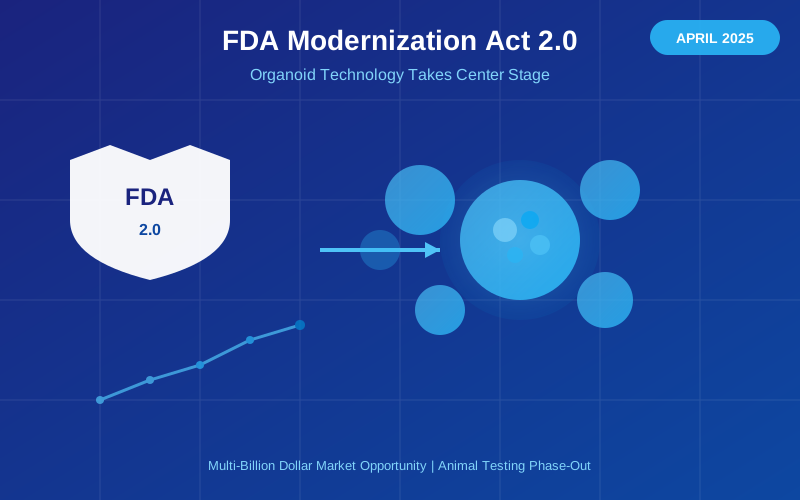
FDA's April 2025 animal testing phase-out initiative drives unprecedented demand for organoid platforms and New Approach Methodologies (NAMs), creating multi-billion dollar market opportunity as regulators make animal studies the exception rather than the norm within 3-5 years.
Recent announcements and community updates from the OrganoBit team.
Based on popular demand, OrganoBit has open-sourced its basic protocol gallery for the public, making every protocol in this library free and accessible to all.
Latest developments in organoid technology and biocomputing innovation
Global collaboration of 20+ experts from 10+ countries including Singapore, China, Australia, and across APAC delivers unified guidelines for organoid biobanking to enhance research reproducibility and accelerate clinical adoption.
EPA Administrator Lee Zeldin announces commitment to eliminate mammalian animal testing by 2035, recognizing organoids as part of the New Approach Methods toolkit. Rodent population in EPA care reduced 91% in just 7 months.
Historic milestone: Qureator and SillaJen achieve FDA approval for oncology drug IND application based solely on vascularized organoid efficacy data, establishing new regulatory precedent without animal proof-of-concept testing.
Senate unanimously passes legislation requiring FDA to update regulations to recognize organoids, organ-on-chip systems, and computational models as regulatory alternatives to animal testing within 12 months.
Pluristyx leads establishment of Organoid COMMONS with 10 industry leaders to create standardized, regulatory-accepted organoid protocols and iPSC banks addressing reproducibility bottlenecks.
FDA releases guidance enabling reduction or elimination of six-month primate toxicity studies, promoting computational toxicology, organoid systems, and real-world human data as validated alternatives.
Grand View Research projects explosive growth from $2.5B in 2025 to $6.27B by 2030, driven by increasing chronic disease prevalence, personalized medicine advances, and reduced reliance on animal testing.
National Institutes of Health launches nation's first dedicated organoid development center at Frederick National Laboratory, using AI and robotics for standardized liver, lung, heart, and intestine organoid protocols.
Breakthrough research creates organoids with integrated blood vessels, overcoming 3mm size limitation and enabling more mature, physiologically relevant models for disease research and drug testing.
Comprehensive analysis of organoid model development standards and best practices for ensuring reliability and human relevance in preclinical drug discovery pipelines.
Market analysis reveals liver organoids leading pharmaceutical adoption due to critical role in drug metabolism testing and toxicity screening applications, with Grand View Research confirming market dominance.
Cambridge biotech company secures funding led by AIX Ventures to scale Clinical Trial in a Dish technology, aiming to reduce $2B and 9 years from drug development timelines using human organoid models.